



- Facility Maintenance

Light Duty Tilt Truck
- Forklift Attachments

Full Featured Work Platform
- Lifting Equipment
Gantry Crane
Stabilizing Jack
- Packaging Equipment
Auto Stretch Wrap Machine
- Safety and Security Equipment
- Storage Solutions
Carton Flow Rack
Cantilever Rack
Pallet Rack Guard
- Caster and Wheels


Top 10 Types of Lifting Equipment in 2026 You Should Know

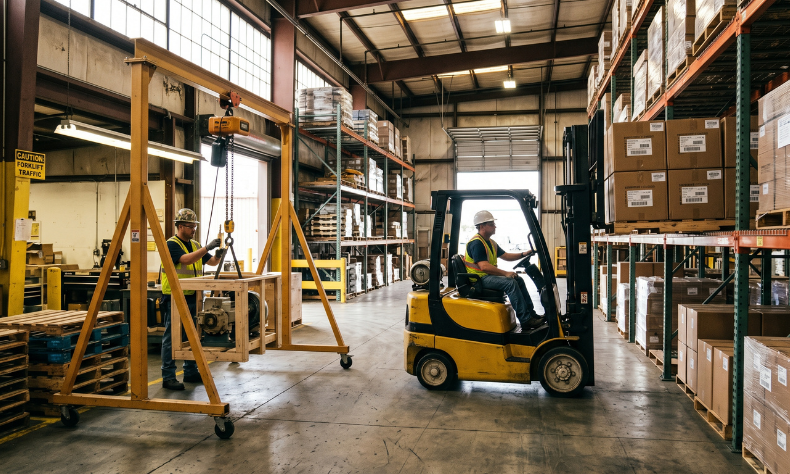
What Are the Top 10 Types of Lifting Equipment in 2026?
Moving heavy objects without compromising safety has always been a problem across all industries. It doesn’t matter if the site is a building manufacturing plant, warehouse or even a maintenance center, companies depend on lifting equipment in order to improve productivity and prevent injuries at work. Knowing the top 10 types of lifting equipment in 2026 will help businesses pick the appropriate equipment to run their business while ensuring safety and productivity.
Modern industrial lifting equipment goes beyond the basic hoists and cranes. Technological advances have brought more efficient load lifting equipment, improved security features, and a variety of special lifting solutions that can handle everything from steel beams and machines up to warehouse inventories and glass panels.
In this article we’ll go over the most commonly used types of lifting equipment available, the ways they’re used, and which industries profit the most from them.
Why Lifting Equipment Matters
Lifting tools play an integral role in material handling operations. They enable workers to lift loads easily, improve operational efficiency, and enhance workplace ergonomics. Lifting equipment supports the workflows of various industries from construction sites to factories, warehouses and more. Choosing the right lifting tool helps companies to meet equipment safety standards and to prevent workplace injuries.
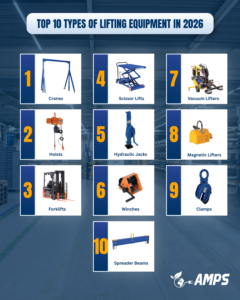
The top 10 types of lifting equipment include:
1. Cranes
Cranes are one of the most extensively used lifting equipment in the world. They help operators to lift, lower, and move heavy materials from place to another.
Common crane types include:
- Overhead cranes
- Gantry cranes
- Jib cranes
- Mobile cranes
- Hydraulic boom cranes
Cranes are most usually found in manufacturing plants, logistics ports, warehouses, construction sites where they are known to provide exceptional lifting capacity. AMPS Supply offers cranes in the form of gantry cranes, and jib cranes which are most commonly used in automotive industries, warehouses, and manufacturing facilities.
2. Hoists
Hoists are lifting tools which consist of chains, wire ropes, and an electric or hydraulic mechanism to raise and lower loads. They can be attached to cranes, fixed structures or trolleys.
Types of hoists include:
Hoists are most commonly used in warehouses, workshops, and factories where lifting of loads with moderate capacities is required. They are known for their precision, and ability to handle repetitive tasks.
3. Forklifts
Forklift is and has always been the most essential element of material handling operations, they are often considered the backbone of modern warehouse systems. Forklifts, unlike cranes and hoists, can transport loads across the worksite while also raising or lowering them.
Forklift equipment are used for:
- Loading and unloading loads from trucks
- Warehouse storage
- Material transport
- Distribution center operations
4. Scissor Lifts
Scissor lifts consist of an elevated work platform with a hydraulic, electric, or manual machinism to lift workers and materials.
They are commonly used for:
- Facility maintenance
- Construction projects
- Inventory management
- Equipment installation
Scissor lifts have improved workplace injuries as they allow workers to move heavy loads without experiencing physical strain, they also reduced manual operations thus improving operational effeciency.
5. Hydraulic Jacks
As the name suggests, hydraulic jacks use a hydraulic mechanism where a fluid pressure is used to lift heavy loads with little force. They are widely used in the automotive industry to lift vehicles for repairs, at construction sites, and distribution centers.
Popular types include:
6. Winches
Winches are lifting tools which use a wire, rope, or cable to pull, position, and move heavy loads.
They are commonly used at:
- Construction sites
- Marine operations
- Industrial facilities
- Recovery and towing applications
Winches are valued for their exceptional load control and are usually integrated into larger lifting equipment systems.
7. Vacuum Lifters
Vacuum lifters use the science of suction to lift materials such as glass sheets, metal sheets, wood panels, timber and more. Vacuum lifters have become increasingly popular in manufacturing and warehouse environments.
Benefits include:
- Reduced manual handling
- Improved workplace safety
- Lower risk of product damage
- Faster material movement
8. Magnetic Lifters
Magnetic lifters use powerful magnets to move iron based materials without the need of supports such as chains, hooks, or slings. These lifting accessories help streamline lifting operations while reducing setup time.
They are ideal for:
- Steel fabrication
- Metal warehouses
- Manufacturing plants
- Machine shops
9. Clamps, Tongs, and Lifting Attachments
Clamps and tongs are essential lifting attachments which are used to grab and secure materials during lifting. These lifting accessories provide better control and improve safety when moving challenging loads.
Common applications include handling:
- Steel plates
- Pipes
- Beams
- Drums
- Concrete products
10. Spreader Beams and Overhead Load Lifters
Spreader beams and overhead lifters are lifting attachments which are designed to distribute the weight of loads evenly across multiple lifting points. They provide load stability, reduce stress on lifting tools, and improve workplace safety.
They are particularly useful when lifting:
- Long materials
- Oversized loads
- Irregularly shaped equipment
- Delicate components

How to Choose Lifting Equipment
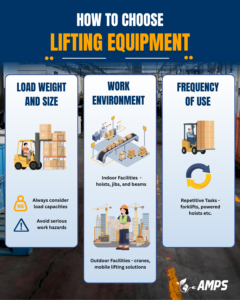
The following factors should be considered while choosing lifting equipment for any facility:
Load Weight and Size
Always consider load capacities when choosing lifting equipment. Lifting loads beyond the tool’s capacity can cause serious word hazards.
Work Environment
Gantry jibs, beams, and hoists are most suitable for indoor lifting operations. On the other hand, outdoor facilities like construction sites benefit from mobile lifting solutions like forklifts.
Frequency of Use
Powered equipment such as electric hoists, or forklifts are most suitable at places where repetitive lifting tasks are required.
Safe Lifting Practices
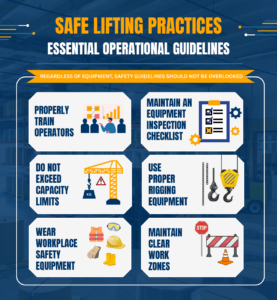
Regardless of the equipment being used, operation managers should make sure that safety guidelines are not overlooked.
Below are some essential safety guidelines which should be implemented:
- Extensively train operators
- Maintain an equipment inspection checklist
- Do not exceed load capacity limits
- Using proper rigging equipment
- Wear workplace safety equipment
- Maintain clear work zones
Regular equipment maintenance, worker trainer, and implementation of safety protocols can significantly reduce workplace accidents.
How AMPS Supply Supports Modern Lifting Operations
Manufacturing facilities, warehouses, factories, and construction sites require strong, durable and reliable lifting solutions to improve operational efficiency and reduce bottlenecks. AMPS Supply offers a wide variety of lifting solutions including: gantry cranes, jib cranes, hoists, winches, vacuum lifters, magnetic lifters, clamps and tongs, spreader beams, overhead load lifters, and crane scales. These lifting tools can enable workers to lift heavy materials with confidence thus improving productivity.
Conclusion
The top 10 types of lifting equipment in 2026 include industrial cranes, hoists, forklifts, scissor lifts, hydraulic jacks, winches, vacuum lifters, magnetic lifters, lifting attachments, and spreader beams. Each plays a critical role in modern material handling equipment systems and helps businesses move loads more safely and efficiently.
By understanding the different types of lifting equipment and selecting the right solution for your application, you can improve productivity, reduce workplace risks, and support long-term operational success.
FAQs
Warehouses commonly use the following lifting equipment: forklifts, hoists, gantry cranes, and jib cranes.
Cranes, forklifts, and hoists are suitable for lifting heavy loads.
Scissor lifts come in manual, electric, semi-electric, hydraulic, electric hydraulic and air rotary options.
The most common crane types include: overhead cranes, gantry cranes, jib cranes, mobile cranes and hydraulic boom cranes.
Spreader beams are used to handle and lift long oversized items, delicate equipment, and irregularly shaped materials.
Procurement managers should consider the following factors when choosing lifting tools – weight of load to be lifted, work environment and frequency of use.
AMPS Supply offers a variety of lifting tools including but not limited to scissor lifts, gantry cranes, jib cranes, vacuum lifters, magnetic lifters, electric and manual chain hoists, clamps, tongs, and spreader beams.
Implement proper safety guidelines, extensively train employees, regularly inspect equipment, and wear safety equipment.
Construction, manufacturing, warehousing, logistics, automotive, and shipping industries use lifting equipment.
Lifting accessories include lifting slings, hooks, clamps, tongs, shackles, and spreader beams.

