


- Facility Maintenance

Light Duty Tilt Truck
- Forklift Attachments

Full Featured Work Platform
- Lifting Equipment
Gantry Crane
Stabilizing Jack
- Packaging Equipment
Auto Stretch Wrap Machine
- Safety and Security Equipment
- Storage Solutions
Carton Flow Rack
Cantilever Rack
Pallet Rack Guard
- Caster and Wheels


Types of Jib Cranes: Uses, Benefits and Key Differences

Types of Jib Cranes: Uses, Benefits, and Key Differences
Various lifting tools are available on the market; choosing the right equipment for your operations can be challenging, but when done correctly, it can make material handling easier and more efficient. Jib cranes are one of the most widely used lifting equipment. Types of jib cranes vary by how they are mounted, how they move, and how they work. Some jib cranes stay in one spot. They are built to be permanently fixed at a workstation. Other jib cranes can be moved; you can take them from one area to another when your tasks change. Knowing the key differences helps you pick the right crane for your space. It also helps you match the crane to your load needs and any lifting situation you have.
What Is a Jib Crane?
A jib crane design consists of a vertical column, a horizontal boom, and a hoist or winch that lifts and lowers loads. While an overhead crane covers a large span of area, a jib crane only covers a particular workstation; this makes it an ideal choice for repetitive lifting tasks in tight workspaces. You can see jib cranes at manufacturing plants, warehouses, production sites, and other industrial workspaces. The model you choose matters. A permanently mounted jib crane suits permanent workstations, whereas a portable unit suits lifting jobs that require moving around a particular area.
Types of Jib Cranes and Key Differences
1. Floor Mounted Jibs

As the name suggests, floor mounted jib cranes are installed directly on the floor of a designated workspace and are permanently fitted there. They consist of a vertical column that supports the horizontal arm for lifting and moving loads. Floor mounted jib cranes are suitable for businesses that require a permanent lifting station; some examples include production lines, loading areas, and parts service.
Common applications:
- Manufacturing
- Machine shops
- Assembly areas
- Maintenance operations
- Loading and unloading
- General material handling
2. Wall Jibs
 Wall jibs are attached to a facility’s wall or a structural support column. They are preferred in workspaces where the floor space is limited. Before installing a wall jib, make sure to assess whether the supporting wall or column is suitable for the jib crane. Pay close attention to the load ratings, mounting requirements, and reach. Wall jibs are well suited for facilities that intend to clear up floor space. AMPS Supply provides two types of wall jibs: low clearance tie rod jibs and high clearance tie rod jibs.
Common Features:
- Attached to a wall support
- Compact design
- Suitable for facilities with limited space
- Easy access for lifting and positioning loads
- Can be mounted at different heights
- Helps reduce the need for floor-mounted equipment
3. Multi-Station Transportable Jib Cranes
 Unlike floor cranes and wall jibs, which are fixed at one workstation, multi station transportable jib cranes can be transported from one workstation to another. Each unit includes the jib crane and a base socket. You can place multiple base sockets throughout the facility, allowing the same crane assembly to serve multiple workstations instead of installing a full jib crane. This is particularly useful for facilities where several workstations require lifting and budgets are tight.
Common Features:
- Portable between multiple workstations
- Uses interchangeable base sockets
- Reduces the need for multiple fixed cranes
- Saves space and installation costs
- Suitable for shared lifting applications
- Flexible solution for facilities with multiple work areas
4. Mini Overhead Cantilever Jibs
 Mini overhead cantilever jibs are also known as compact workstation jib cranes. They provide lifting assistance in areas where space is limited – benches, work cells, assembly areas, and maintenance stations. These jib cranes are designed to move items from carts to workbenches. This allows operators to handle heavy loads without relying on manual effort. These compact units are used in spaces where a crane cannot fit and repetitive lifting tasks are required.
Common Features:
- Compact design for workstation applications
- Suitable for benches and work cells
- Helps reduce manual lifting
- Ideal for repetitive lifting tasks
- Supports cart-to-workbench material handling
- Fits into areas with limited overhead space
5. Extra Travel Tri-Post Jibs
 Three post workstation jib cranes are fixed-height lifting tools designed with an extended horizontal beam. The extended beam allows longer usable travel length for moving loads across a workstation. These jibs are positioned over a workbench and are used in repair shops, production workbenches, assembly areas, and maintenance stations. The three-post frame creates a sturdy overhead lifting solution for industrial use.
Common Features:
- Extended horizontal beam for longer travel
- Fixed-height design
- Three-post frame for added stability
- Suitable for workbenches and repair stations
- Supports lifting across a wider work area
- Designed for industrial workstation applications
6. Portable Jib Cranes
 Portable free standing jib cranes are an ideal solution for facilities where a permanently mounted crane is not suitable. These jib cranes are designed with a transportable base and built-in fork tubes; this allows the jib cranes to be moved via a forklift to accommodate changing lifting needs and workplace layouts. The main difference between multi-station transportable Jib cranes and portable jib cranes is that the latter can be moved from one workstation to another.
Common Features:
- Transportable between work areas.
- Includes built-in forklift tubes
- No permanent floor mounting required
- Flexible for changing workspace layouts
- Suitable for temporary lifting applications
- Can be positioned where lifting is needed
7. Truck Jib Cranes
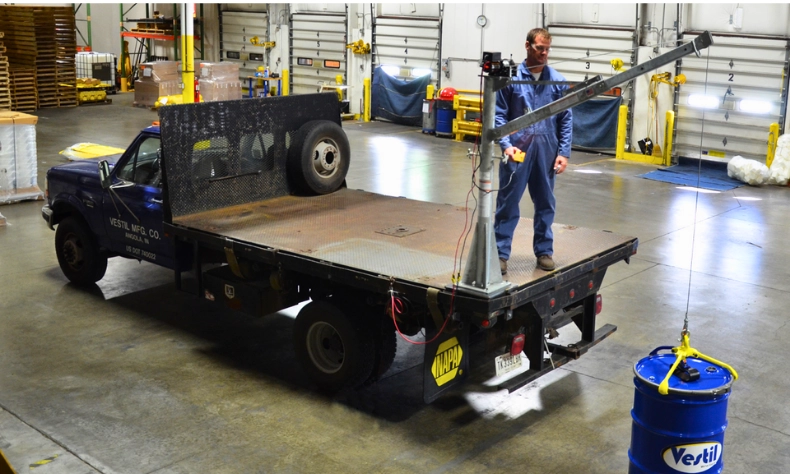
 Truck jib cranes are an efficient lifting solution for pickup truck beds, service vehicles, workshops, maintenance locations, and field service applications. These cranes can be mounted on a compatible truck bed or fixed at a location. They allow operators to load, unload, and position heavy loads with less manual effort. AMPS Supply provides the following truck jib crane options:
- Hitch-Mounted Truck Jib Crane
- Winch-Operated Truck Jib Cranes
- Powered Truck Jib Cranes with Electric Cable Winches
Common Features:
- Suitable for trucks and service vehicles
- Helps load and unload heavy equipment
- Useful for field service and maintenance work
- Available with manual or powered operation
- Supports lifting in remote or mobile work areas
- Reduces manual handling of heavy loads
Jib Crane Uses and Applications
Jib cranes are an ideal overhead lifting solution for lifting support around a focused workstation. Jib cranes are used in manufacturing sites at assembly and production areas for the movement of material and heavy components. Jib cranes found in maintenance departments can be seen lifting motors, machine parts, and other components. In warehouses, you may see jib cranes operating around a specific workstation, loading area, or maintenance section. Truck-mounted jib cranes are usually seen at service businesses where job locations change frequently.
Some common jib crane applications include:
- Machine loading and unloading
- Assembly operations
- Maintenance and repairs
- Equipment servicing
- Material positioning
- Loading and unloading vehicles
- Moving components between nearby workstations
- Handling heavy tools and equipment
Benefits of Using Jib Cranes

Saves Time
Jib cranes are conveniently available at workstations for lifting support, thus enabling workers to save time rather than moving between locations to carry loads.
Reduces Manual Handling
Jib cranes reduce manual effort, especially where repetitive lifting tasks are required. This can enhance workplace ergonomics and efficiency.
Makes Better Use of Workspace
Wall-mounted jib cranes and similar compact designs occupy less space while providing the required lifting support.
Offers Flexible Options
Jib cranes provide flexible options – fixed, portable, powered, and truck-mounted designs. Businesses can choose the jib crane best suited for their operations.
Supports Different Applications
Jib cranes support a wide variety of industrial applications, from field service and maintenance to warehouse operations and production lines.
Final Thoughts
The right jib crane can change how a site moves heavy items. You may see fixed cranes on floors or walls. Some setups use portable units. Other jobs rely on systems built onto trucks. Each option fits a different workflow.
If you compare jib cranes, look at a few key details. Check the load rating. Then review the reach and the lift height. You should also note how the crane mounts. Mobility matters, too, along with the way it is operated. When you choose based on the real job, you usually get better results from the lifting gear. It also makes daily handling easier.
AMPS Supply carries jib cranes for many settings. These include industrial, commercial, maintenance, warehouse, and mobile work. If you want a crane for a set station, a movable option, or a truck setup, start by listing what you must lift and how you will use it.
FAQs
Jib cranes are used for lifting and moving loads within a specific work area.
The main types include floor-mounted jibs, wall jibs, multi-station transportable jib cranes, extra-travel tri-post jibs, portable jib cranes, truck jib cranes, and power-lift jib cranes.
A floor-mounted jib crane is installed and fixed on the floor, whereas a wall-mounted jib crane is installed on a wall support or structural column. Floor-mounted jib cranes occupy more space.
Portable jib cranes are movable jibs designed with a transportable base equipped with fork tubes, which allows easy movement via forklifts.
Truck jib cranes are an efficient lifting solution for pickup truck beds, service vehicles, workshops, maintenance locations, and field service applications.
A hitch-mounted truck jib crane is designed to mount into a compatible truck receiver. A power lift jib crane uses an electric cable winch for powered lifting. They are separate designs intended for different lifting requirements.
First, figure out the biggest load weight you will lift, along with the lift height you need. Also note the horizontal reach and the size of the working area. Next, decide which crane type fits your job. Also look at how often you will use the crane. Check the space you have on site. Review how the unit must be mounted. Consider the job setting where it will run.
Not usually. Jib cranes and forklifts are designed for different material handling tasks, and both have different features and benefits.
Yes, jib cranes are suitable for industrial applications. They are found in warehouses, factories, maintenance areas, machine shops, and repair centers
Check the crane’s rated load. Also look at its reach and how high it can lift. Confirm the mounting style and whether the site has enough room. Make sure the base and supporting parts can take the load. The work area must fit that particular crane. Follow the maker’s instructions for both setup and use.

