



- Facility Maintenance

Light Duty Tilt Truck
- Forklift Attachments

Full Featured Work Platform
- Lifting Equipment
Gantry Crane
Stabilizing Jack
- Packaging Equipment
Auto Stretch Wrap Machine
- Safety and Security Equipment
- Storage Solutions
Carton Flow Rack
Cantilever Rack
Pallet Rack Guard
- Caster and Wheels


Trailer Mover vs Trailer Dolly: What’s the Difference?

Trailer Mover vs Trailer Dolly: What’s the Difference?
Anyone who has tried to park a trailer in a narrow driveway knows how annoying it can get. We turn, pull forward, try again, and still end up a foot off. Sometimes it isn’t even worth hooking up the car for such a small move.
That’s why people start looking for equipment that can move the trailer for them. And that’s where the Trailer Mover vs Trailer Dolly question comes up. They look alike at first, and both help us position a trailer, but they aren’t the same thing. We’re Amps Supply, and customers ask us about this all the time. Here’s a plain explanation of the difference between a trailer mover and a trailer dolly, and how to choose the right one.
What Is a Trailer Mover?
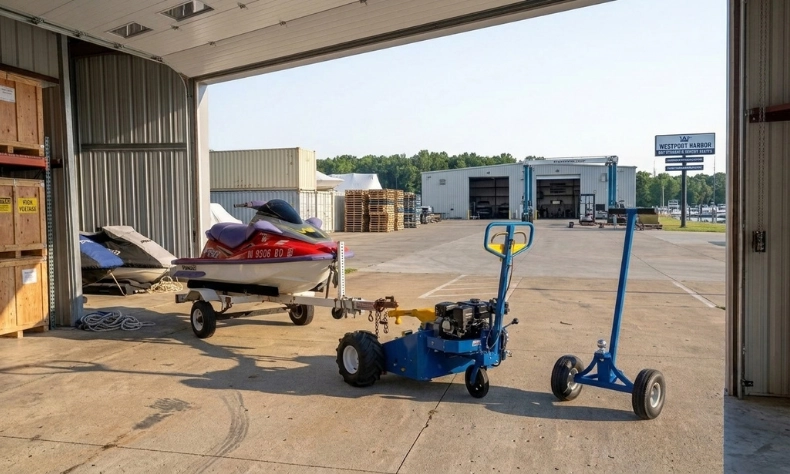
A trailer mover helps shift a trailer a short way without towing it with our car. For example, the trailer may be in our driveway and we just need it moved a few feet to the left, or slid back into the storage spot. Getting another vehicle attached can take time. A mover can get the job done fast, often in just a couple of minutes.
There are two main kinds. Some units are manual. Others are powered. With an electric trailer mover, a motor does most of the pushing, which is useful when the trailer is heavy or when we move it a lot. A powered trailer mover also uses a motor. Many models include a remote, so we can stand near different sides of the trailer and keep an eye on it while it moves.
What Is a Trailer Dolly?
A trailer dolly is the older, simpler option. It clips onto the hitch or coupler and has a small wheel and a handle. We hold the handle, steer, and walk the trailer to where we want it.
A manual trailer dolly depends on our own strength. If our trailer is small and light, and we only move it once in a while, that’s often all we need. There is also an electric trailer dolly, which has a motor so we don’t have to do all the pushing ourselves.
Trailer Mover vs Trailer Dolly: The Main Difference
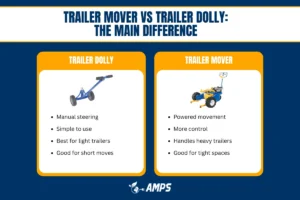 Put simply, a dolly is a basic tool for steering a trailer by hand. A mover is usually built to give us more power and control, especially the motorized ones.
- Dolly: simple, good for light trailers, best for short moves now and then.
- Mover: more help, better for heavy trailers, tight spaces, and regular use.
Neither one is better in every case. Someone with a small garden trailer will probably be happy with a dolly. Someone with a heavy trailer in a tight spot will likely want a powered mover. So we should look at our own situation instead of searching for one answer that fits everyone.
Manual or Powered?
Manual equipment is easy to live with. There’s no battery to charge and no motor to worry about. For lighter trailers, it works fine.
Powered equipment does the hard work for us. It helps a lot when the trailer is heavy, or when we have to move it a little in a tight area. We do lose some simplicity, though. We have to watch a few extra parts, such as the battery and the motor, and we also need to check that the weight stays within the stated cap.
When Does a Mover Make Sense?
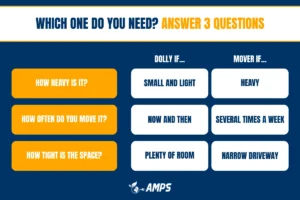 A mover is a good fit if we often move our trailer without attaching a vehicle. A narrow driveway is the classic example. We may have space for the trailer but not enough room to bring the car around. A crowded storage area is another one. In places like these, trailer moving equipment gives us an easier way to get the job done.
It works well for:
- Utility trailers
- Boat trailers
- Workshop trailers
- Commercial trailers
- Home driveways and garages
- Storage areas
Caravan owners use them a lot too. A caravan mover is great when we need to place a caravan carefully at a campsite or in a storage yard. Some people just call it a trailer mover machine, and that’s fair, because the machine does the heavy work while we steer.
When Is a Dolly Enough?
A dolly is a good match when our trailer is small, and we don’t move it much. Imagine a light utility trailer beside our garage that needs to go a few metres. Hooking up a vehicle can take longer than the move itself. With a dolly, we just clip on and go.
A manual trailer dolly also suits people who like keeping things basic. No battery, no motor, fewer parts to go wrong. We just shouldn’t push it past its limit. A dolly made for a small trailer should never be used on a much heavier one.
Trailer Maneuvering Made Easier
Trailer maneuvering feels strange at first. A trailer rarely turns the way we expect, especially in small spaces. The trick is to go slow. Short, steady moves are much easier to control than quick ones.
Good trailer maneuvering equipment helps, but it can’t replace common sense. Before we start, look around for walls, cars, people, or uneven ground. If we’re using a powered unit, get used to the controls in an open area before we try a tight one.
Trailer Parking Without the Stress
Trailer parking gets easier when we know exactly where the trailer should end up. Decide that first, then move slowly and adjust a little at a time. Also check the ground. Grass, gravel, and concrete all feel different under a dolly or mover.
A few quick habits help:
- Check our trailer’s weight before choosing equipment.
- While the trailer is moving, clear the area first.
- Keep other people out of the way.
- Look over the equipment before you use it each time.
- Then follow the directions written for that product.
Choosing the Right Equipment With Amps Supply
At Amps Supply, we believe buying trailer towing equipment isn’t about grabbing the first product we see. A light utility trailer has very different needs from a big caravan or a commercial trailer.
So our advice is to start with the trailer, not the product. Write down its weight, size, hitch type, and how often we move it. Think about the ground where we’ll use it, too. Once we have those details, comparing Trailer Mover vs Trailer Dolly gets much easier, and the list of options shrinks fast.
Things to Check Before Buying
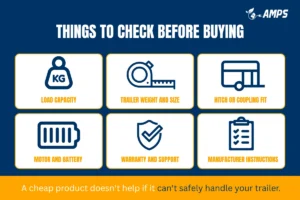 It’s easy to focus on price, but a cheap product doesn’t help if it can’t safely handle our trailer. Check these before we buy:
- Maximum load capacity
- Trailer weight and size
- Hitch or coupling fit
- Motor and battery details
- Warranty and available support
- Manufacturer instructions
Think about how often we’ll use it, too. If we move a small trailer a few times a year, a simple tool is enough. If we move a heavy one several times a week, look for something made for regular use.
FAQs
Amps Supply offers trailer equipment that makes moving and towing easier. The right product depends on our trailer’s type and size.
We focus on practical equipment that makes trailer handling simpler. We can compare specifications and pick what fits our needs.
Yes. Keep our trailer’s weight, size, hitch type, and how we use it ready. That makes the choice much easier.
Yes, but every trailer is different, so always check the product against our trailer’s specifications. We can point us to options that suit our needs.
It helps us move and position a trailer without using a towing vehicle each time. Powered models also cut down the physical effort.
It’s used to move and steer a trailer, usually over short distances. Manual ones need our strength, and powered ones use a motor.
Yes. It makes small movements easier, especially when space is tight.
Start with its total weight, size, and hitch type, and think about where we move it. Then compare that with the equipment’s rated capacity.
Only if it’s clearly rated for that weight, don’t guess by looks. Always check the manufacturer’s rating.
Inspect it, check its capacity, connect it properly, and clear the area. Then move slowly and follow the instructions.

