



- Facility Maintenance

Light Duty Tilt Truck
- Forklift Attachments

Full Featured Work Platform
- Lifting Equipment
Gantry Crane
Stabilizing Jack
- Packaging Equipment
Auto Stretch Wrap Machine
- Safety and Security Equipment
- Storage Solutions
Carton Flow Rack
Cantilever Rack
Pallet Rack Guard
- Caster and Wheels


What Types of Industrial Trash Compactors Are Available?

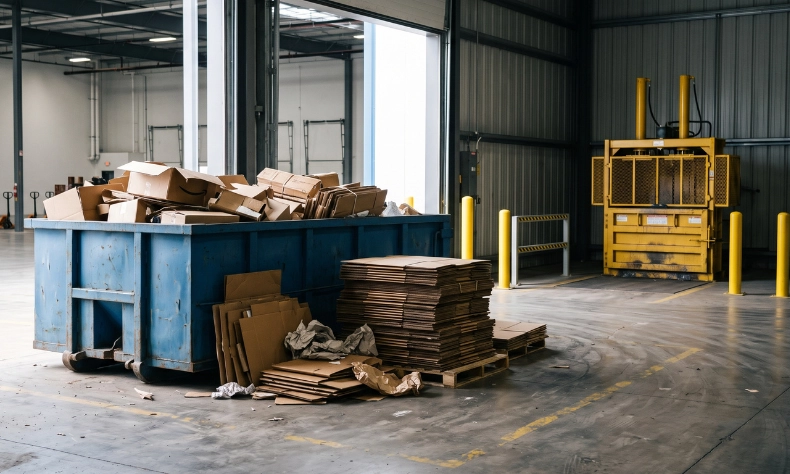
What Types of Industrial Trash Compactors Are Available?
A customer called us last spring, a little annoyed. His warehouse was paying for dumpster pickup three times a week, and the bin was still full by Wednesday. Most of it was air. Boxes, foam, loose wrap, all sitting there taking up room. We told him what we tell most people in that spot: you probably need an industrial trash compactor.
If you are stuck, try the choices in this guide. It goes over each option in simple words. Then you can decide what fits your website.
What Does a Compactor Do?
A compactor just presses stuff down. It uses a ram or a flat plate to push on the trash. The pile gets tighter. Because of that, the same amount of waste takes up far less room. That can mean fewer trips for the truck. It can also mean lower costs on the bills you get.
You might see many labels for it. Some people say commercial trash compactor. Others call it an industrial waste compactor. You may also hear garbage compactor or compactor machine. Most of these are pointing to the same kind of equipment, so the exact name should not slow you down.

Why People Buy One
Cost is the big reason, but there are others. Owners tell us they like that:
- the dumpster gets emptied less often, so the monthly bill drops
- walkways stay clear
- nobody has to climb into a bin to stomp boxes flat (this happens more than you’d think)
- less waste goes to the landfill, which matters for waste volume reduction goals
The Main Types
Stationary Trash Compactor
This one is fixed in one spot and hooked to a big container. Staff throw trash in a hopper and the ram pushes it into the container. You’ll find a stationary trash compactor behind supermarkets, malls, and factories. If your bins fill up all day, this is the usual heavy duty trash compactor choice.
Self Contained Trash Compactor
The machine and the container are built as one closed unit. Because it’s sealed, liquid doesn’t leak and the smell stays inside. Restaurants and hospitals like a self contained compactor for exactly that reason. Emptying it is simple too.
Vertical Trash Compactor
It presses downward, so it doesn’t need much floor. If all you have is a small corner at the back, a vertical trash compactor can squeeze in there. It copes with light and medium loads. Very big loads are a different story.
Horizontal Trash Compactor
The ram pushes sideways into a long container. Bulky stuff like crates and large boxes goes in without much trouble. A horizontal trash compactor is what many warehouses pick when volume is high. It counts as a real high capacity trash compactor.
Hydraulic Trash Compactor
Fluid pressure drives the ram, and that means a lot of force. Hydraulic compaction gives a high compaction ratio, which just means a big pile of waste turns into a small, hard block. For machines that run every day, a hydraulic trash compactor is where you’d usually end up.
Mechanical Trash Compactor
A mechanical trash compactor has no hydraulics. It works with levers, gears, or a ratchet. It’s cheaper, there’s very little to maintain, and it doesn’t need power at all. For a small shop with light jobs, that’s often plenty.
Industrial Cardboard Compactor
Cardboard is light but bulky, so it fills a dumpster very fast. An industrial cardboard compactor flattens it and presses it tight. It also keeps cardboard apart from other trash, which helps if you recycle.
Equipment Available at Amps Supply
Not everyone needs a fixed machine, and plenty of our customers run small or mid-sized sites. For them, we offer:

- Manual Drum Compactor, 30-gallon (MTC-30): Fits a 30-gallon drum, which isn’t included. A ratchet drives it and it gives up to 7,000 lbs of force.
- Manual Drum Compactor, 55-gallon (MTC-55): Same idea for a 55-gallon drum. It has two wheels, so you can tilt it back and roll it around when it’s empty.
- Forklift Waste Bin Compactor (FWBC-4242-2 and FWBC-4242-4-BC): A forklift sets it inside a waste bin, and its own weight crushes the trash. It has fork pockets, a safety chain, and adjustable height. The first model is rated for 2,000 lbs filled weight. The second handles 4,000 lbs and has a cement-filled base.
- Manual Bin Compactor (MBC-1513-14): A lever tool for 64 and 95 gallon bins. It’s powder coated steel and presses about 14 inches down. Useful when the commercial dumpster is stuffed and pickup is two days away.
Stock changes from time to time, so contact our team before you order.
How to Pick the Right One
Skip the long list. Just be straight with yourself.
- What are you tossing out? Regular trash, cardboard, or both?
- In an average week, how much piles up?
- How much room do you actually have for it on the floor?
- How much floor space can you spare?
- Do you want a powered machine or a manual one?
- What do you pay for pickups right now?
Then look at the compactor capacity and force rating on the machine and make sure they match your waste. Small shops can usually manage with a manual unit. Bigger plants will probably want a stationary or self-contained industrial waste compactor.

A Few Safety Habits
Compactors are safe if you use them right. A few rules:
- Look over the manual before you start.
- Keep your fingers away from any part that moves.
- Use only the rated load.
- Lock the ram or lever when you’re finished.
- Wipe the area down after use.
- Check for wear now and then.
- Look after it, and a compactor machine should run for many more years.
FAQs
We supply industrial and commercial equipment. A big part of our work is helping businesses find waste management equipment that suits them.
We sell manual drum compactors, bin compactors, forklift bin compactors, and other material handling equipment.
We keep things plain. You get solid products, clear advice, and an easy ordering process.
The compactors are manufactured from a strong metal that lasts. There are ratings for each model, though.
Yes. Let us know what you dispose of and the approximate quantity so we can recommend an appropriate one.
We do. We help with ordering and shipping. Delivery times vary depending on the item and your location.
Sure. Get in touch, and we’ll tell you what’s available.
A stationary one connects to a separate container. A self-contained one has the machine and container in one sealed body, so you get fewer leaks and less smell.
It depends on the waste and the machine. The compaction ratio shows how much a machine shrinks things. Hydraulic models usually shrink waste more than manual ones
Put the drum on flat ground and add waste a little at a time. Move the ratchet lever slowly. When you’re done, lock it in the up position. Never put your hands inside the drum.

