



- Facility Maintenance

Light Duty Tilt Truck
- Forklift Attachments

Full Featured Work Platform
- Lifting Equipment
Gantry Crane
Stabilizing Jack
- Packaging Equipment
Auto Stretch Wrap Machine
- Safety and Security Equipment
- Storage Solutions
Carton Flow Rack
Cantilever Rack
Pallet Rack Guard
- Caster and Wheels


Gantry Crane Types, Uses, Benefits & Buying Guide

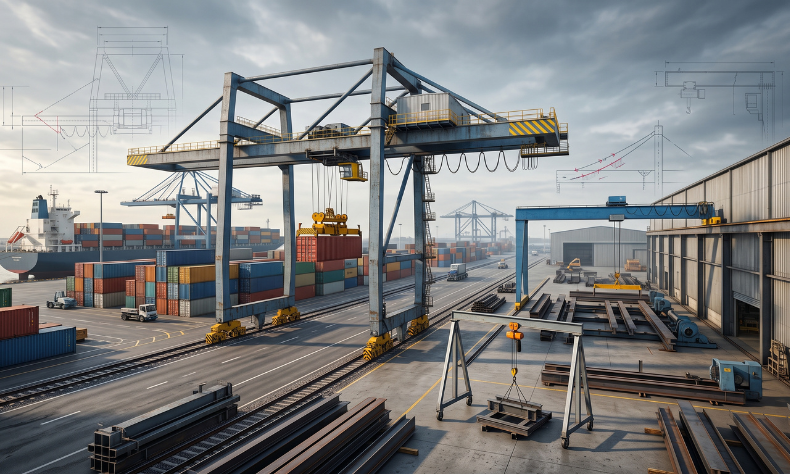
What Are Gantry Cranes?
A gantry crane is a form of lifting equipment which comprises two supporting legs connected to a horizontal beam along which a trolley and hoist travel to move and lift heavy loads. Gantry cranes range from being with caster wheels or installed over tracks which makes mobility easy from one work area to another. All gantry cranes operate under the same principle. The crane consists of a horizontal beam which is called a bridge beam. A hoist is attached to a trolley which moves along the beam. A gantry crane may be equipped with roll-on-wheels, or tracks to allow mobility between work stations.
Equipment operators can use manual chain hoists, electric hoists or pneumatic lifting equipment depending on the type of task to be handled and crane’s lifting capacity. Gantry cranes allow operators to move loads with excellence control while reducing the need for manual lifting.
In the following article we will explore different gantry crane types, their uses, benefits and tips on how to choose the right crane.
Types of Gantry Cranes
Gantry cranes can be classified on the basis of size, design, load capacity, mobility and usage. The five most common gantry crane types include: full gantry cranes, semi gantry cranes, portable gantry cranes, adjustable gantry cranes, and mobile gantry cranes.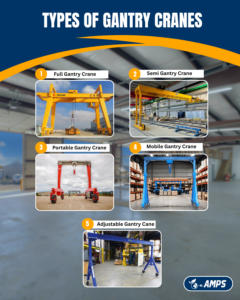
1. Full Gantry Cranes
Full gantry cranes are heavy duty cranes as they are largest and strongest among all other types. They consist of two supporting legs which travel on tracks or rails allowing them to move on a fixed path while carrying heavy loads.
These cranes are commonly used in:
- Manufacturing plants
- Steel mills
- Shipyards
- Rail yards
- Large industrial facilities
Due to their large size and high lifting capacity, these cranes are generally used for heavy duty industrial applications where lifting and movement of several tons of loads is required.
2. Semi Gantry Cranes
A semi gantry crane is a combination of a gantry crane and an overhead crane. Unlike a full gantry crane which has two legs, a semi gantry crane consists of a one leg that travels on a ground rail, while one side of the crane is supported by an overhead beam attached to a building’s structure.
These cranes are commonly used in:
- Manufacturing plants
- Production facilities
- Warehouses with partial structural support
- Facilities looking to maximize floor space
3. Portable Gantry Cranes
They are lightweight, easy to assemble and require little or no building modification.
Portable gantry cranes are one of the most widely used cranes in work areas that require mobile and flexible lifting equipment. Unlike other cranes, they are not fixed or permanently installed, instead they use caster wheels to move from one place to another. These cranes require little to no modification to the building’s structure, are easy to assemble and are ideal for medium-duty lifting.
Portable gantry cranes are commonly used in:
- Maintenance workshops
- Automotive repair facilities
- Small manufacturing plants
- Equipment installation
- Warehouse maintenance
AMPS Supply offers several portable steel and aluminum gantry crane models designed for industrial material handling applications.
4. Adjustable Gantry Cranes
As the name suggests, adjustable gantry cranes allow operators to change the height of the beam. Some models even allow you to adjust the span to accommodate different lifting requirements. These cranes are most suitable in areas where material with varying loads need to be handled.
AMPS Supply offers a wide range of adjustable steel and aluminum gantry cranes, including models with:
- V-Groove Casters
- Total Locking Casters
- Pneumatic Casters
- Adjustable Leveling Options
- Knockdown designs for easier transportation and storage
These options allow businesses to select a crane that matches their specific operating environment.
5. Mobile Gantry Cranes
A mobile gantry crane allows operators to move the crane freely around a work area without the need for fixed tracks. As these cranes are mounted on heavy duty wheels or cranes, they can be easily moved from one workstation to another and accommodate changing facility layouts.
They are commonly used for:
- Construction projects
- Warehouse operations
- Equipment installation
- Industrial maintenance
- Temporary lifting applications
Mobile gantry cranes are a cost effective solution for businesses that require the use of gantry cranes at multiple points in a facility.
Gantry Crane Uses
All gantry crane types are highly desired across industries due to their versatility and flexibility. Unlike other fixed lifting systems, gantry cranes can be used in various environments: from a small workshop to a large construction site. Due to this feature, they have become an essential element of modern material handling equipment.
Here are some of the most common gantry crane applications.
Warehouses and Distribution Centers
Gantry cranes are used in warehouses to move pallets, heavy inventory, machinery, and irregular and oversized objects. Portable and mobile gantry cranes are widely used in warehouses and distribution centers as they can be moved from one workstation to another as operational needs change.
Manufacturing Facilities
Manufacturing plants use gantry cranes to handle and move raw materials, production equipment, finished products and molds throughout the manufacturing plant. As the production layout can change from time to time, adjustable gantry cranes are commonly used without requiring the need for structural modifications.
Construction Projects
Construction sites require the movement and handling of heavy steel beams, HVAC units, concrete elements, generators and other heavy construction materials. Industrial gantry cranes allow construction sites a practical solution by allowing operators to reposition the crane easily as the project progresses.
Maintenance and Repair Shops
Maintenance areas and repair shops often need to move motors, pumps, engines, compressors and industrial machinery for repairs. Portable gantry cranes can help maintenance teams by making lifting operations easier. They can provide a temporary lifting solution where the servicing is required and be easily moved to the next work area after completion.
Fabrication and Machine Shops
Fabrication facilities and machine shops require the handling of heavy metal components which often require precise positioning. Gantry cranes allow operators to lift and move steel plates, pipes, machine components and assemblies. This enables them to improve workplace safety and workflow efficiency.
Benefits of Gantry Cranes
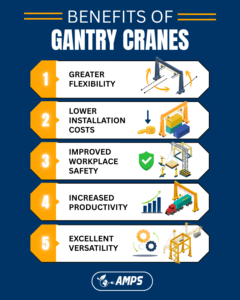 Industries continue to use gantry cranes as they provide flexibility, workflow efficiency and worker safety which many other lifting systems cannot provide.
1. Greater Flexibility
Unlike overhead cranes which are permanently installed, gantry cranes can be moved from one place to another to accommodate changing production layouts and operational requirements. This flexibility and mobility make them an excellent choice for facilities that require lifting of materials at multiple work points.
2. Lower Installation Costs
Since many gantry cranes are not attached to a building’s structure, little to no modification is required to an existing building. Loads can be lifted without the need for permanent runway systems. This enables businesses to cut installation and assembly costs.
3. Improved Workplace Safety
Industrial gantry cranes reduce the need for manual material handling and help minimize workplace injuries. Routine inspections combined with personnel training can help improve workplace safety and ensure compliance with crane safety standards.
4. Increased Productivity
Gantry cranes reduce the need for manual material handling which is time consuming and physically demanding. They allow operators to safely lift, move, and position loads quickly, reducing time consumed and improving overall productivity.
5. Excellent Versatility
Gantry cranes are known for their versatility as they can adapt to various work environments: from moving steel beams on a construction site to moving inventory in a warehouse, gantry cranes can be used for a wide range of applications. Caster wheel options, hoists, beam heights and capacities allow users to customize the crane for their special lifting needs.
How to Choose a Gantry Crane – Buying Guide
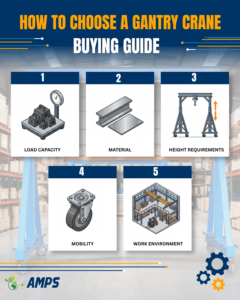 Different work environments call for the need for different gantry cranes. Lifting requirements, facility layout and operational needs all play a role in determining the right gantry crane.
Here are a few key factors to consider.
Load Capacity
Determine the average and maximum weight the gantry crane is expected to lift. Always select a crane with a higher lifting capacity than the maximum weight to ensure an appropriate safety margin.
Material
Steel gantry cranes are ideal for heavy-duty industrial applications as they provide high durability, strength and higher lifting capacities.
Aluminum gantry cranes are most suitable for operations that require medium to light industrial applications, or require movement from one workstation to another.
Height Requirements
If lifting heights vary based on operations then an adjustable gantry crane is the most suitable for your facility as it provides greater flexibility than a fixed-height crane.
Mobility
Ascertain whether the gantry crane is required to be moved from one workstation to another. If required, then a portable or mobile gantry crane is the most suitable for your operations.
Work Environment
Choose a gantry crane on the basis of your work environment. An adjustable, portable and mobile gantry crane is most suitable for warehouses and automotive repair shops. On the other hand, a heavy duty gantry crane would suit the environment of a construction site.
How AMPS Supply Supports Your Lifting Needs
Every workplace has unique lifting requirements, which is why AMPS Supply offers a broad range of gantry crane solutions designed for different industries and applications.
Its product range includes:
- Adjustable Steel Gantry Cranes
- Adjustable Height Aluminum Gantry Cranes
- Fixed Steel Gantry Cranes
- Fixed Height Aluminum Gantry Cranes
- Knockdown Gantry Cranes for easier transportation
- Models with V-Groove, Pneumatic, and Total Locking Casters
- Adjustable Leveling Options for uneven surfaces
AMPS Supply caters to the need for every industry and provides lifting solutions for both light weight and heavy duty applications. Our cranes can help businesses improve productivity, efficiency and workplace safety.
FAQs
A gantry crane is a lifting equipment supported by two legs and consists of a horizontal beam. A trolley and hoist moves along the beam to lift heavy loads.
The five main types of gantry cranes are full gantry cranes, semi gantry cranes, portable gantry cranes, adjustable gantry cranes, and mobile gantry cranes.
A trolley and hoist travels along the horizontal beam. The hoist lifts and lowers objects while the trolley moves across the beam.
Gantry cranes are used for moving, handling, and lifting heavy loads in various industrial settings.
A gantry crane is supported by two legs and can be moved from one place to another. On the other hand, an overhead crane is fixed to a building’s runway system.
Consider the following factors to choose the right gantry crane – maximum load capacity, lifting height, available workspace, work environment, mobility and material.
Yes. Portable gantry cranes are widely used for industrial applications as equipment repairs, machine installation, warehouse operations, and manufacturing.
Gantry cranes should be inspected on a daily basis to prevent workplace injuries. Detailed inspections and maintenance should be carried out on the basis of the manufacturer’s recommendations.
The price of a gantry crane can depend on its lifting capacity, type, lifting height, beam spam, structure material, caster type, and any other custom features of accessories.
AMPS Supply offers a wide range of adjustable and portable gantry cranes designed to suit your specific material handling needs while ensuring long term durability, safety and efficiency.. You can also customize a gantry crane for your unique operations

