


- Facility Maintenance

Light Duty Tilt Truck
- Forklift Attachments

Full Featured Work Platform
- Lifting Equipment
Gantry Crane
Stabilizing Jack
- Packaging Equipment
Auto Stretch Wrap Machine
- Safety and Security Equipment
- Storage Solutions
Carton Flow Rack
Cantilever Rack
Pallet Rack Guard
- Caster and Wheels


Types of Lift Carts: Which One Is Right for You?

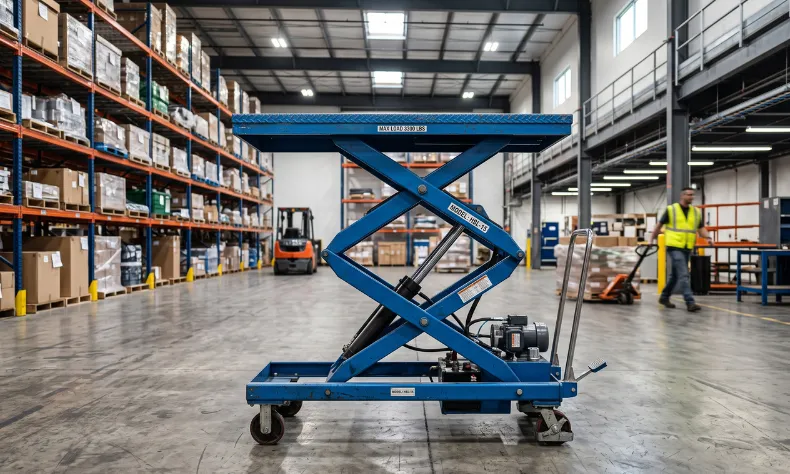
Are you considering buying a lift cart but confused about which type to choose? Don’t worry! You’ve landed in the right place. Lift carts come in various sizes, designs, and lift capacities, which can make decision-making challenging, especially if you are not familiar with material handling. In this blog, we will highlight the different types of lift carts, their uses, and their functionality.
Now, first and foremost, let’s discuss what a lift cart is.
What Is a Lift Cart?
A lift cart is a mobile material handling equipment that can raise, lower, and move loads from one place to another. Although a lift cart may sound identical to a traditional cart, it allows loads to be lifted vertically. On the other hand, platform carts move loads horizontally. This feature significantly reduces manual labor, as workers no longer need to bend down to pick up materials, which can cause back injuries, physical strain, and fatigue.
Workers can simply raise boxes, parts, tools, pallets, containers, and loads using a lift cart to the required height. Lift carts are available with different lifting mechanisms, including hydraulic, manual, and electric systems. The best choice depends on the required lifting height, the nature of the tasks to be handled, and the operating environment.
Why Use a Lift Cart?
Why use a lift cart when there are other types of industrial material handling equipment? Well, the answer lies in efficiency and practicality. Lift carts allow workers to move loads vertically without experiencing physical strain. Since manual material handling is reduced, worker efficiency improves greatly. On the other hand, unlike forklifts and stackers, lift carts are compact in size and can move through narrow spaces easily. Moreover, lift carts are the most practical choice for small and repetitive tasks.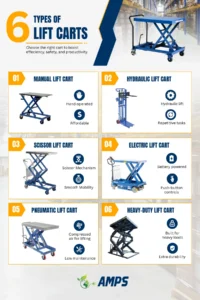
Types of Lift Carts
1. Manual Lift Cart
A manual lift cart is the simplest form of a lift cart. It consists of a foot-operated pump that can be hydraulic or based on another mechanical system. The cart is moved manually via wheels, and loads are lifted without an electric motor. Usually lower in cost, these carts are suitable for warehouses, workshops, and small production facilities that require occasional lifting assistance. These carts are simpler to use but require more physical effort, especially for repetitive lifting tasks
2. Hydraulic Lift Cart
A hydraulic lift cart consists of a hydraulic system where a foot pedal or hand controller triggers hydraulic pressure, which in turn enables the operator to raise and lower the cart. Hydraulic lift carts are widely used across warehouses and industries for their controlled lifting and ability to handle repetitive tasks. There are many different sizes and capacities to choose from, so make sure to pay close attention to the manufacturer’s rated load capacity when buying a hydraulic lift cart.
3. Scissor Lift Cart
A scissor lift cart consists of crossed metal supports under its platform, hence the name “scissor cart”. When the metal supports contract, the platform moves down; whereas when the metal supports expand, the platform moves up. These lift carts are widely used across warehouses, construction sites, manufacturing plants, and maintenance sites as they provide stable lifting and smooth maneuverability. When choosing a scissor cart, make sure to note both its maximum lift height and its lowest platform height to ascertain whether the cart in question is suitable for your specific application.
4. Electric Lift Cart
An electric lift cart uses a battery-powered motor to raise and lower the platform. Some models have control buttons mounted on the handle of the lift cart, while some have a separate control system. Electric lift carts are preferred over manual and hydraulic lift carts in situations where operators are required to lift items numerous times a day. Since these carts operate on batteries, they reduce manual lifting and enable workplaces to improve their operational efficiency. If you think an electric lift cart is most suitable for your operations them make sure to choose a cart with a battery capacity long enough to support your normal work schedule.
5. Pneumatic Lift Carts
Pneumatic lift carts use compressed air to raise and lower loads as opposed to utilizing manual pumping or an electric motor. Facilities that already have a compressed air system may prefer to use a pneumatic lift cart as a dependable material handling solution without adding any electrical components. These carts are used in various industries such as manufacturing plants, maintenance areas, and workshops. The factors to consider when choosing a pneumatic lift cart are available air pressure, required lifting height, load capacity, and frequency of lifting tasks.
6. Heavy Duty Lift Cart
As the name suggests, a heavy-duty lift cart is utilized for heavy lifting and demanding applications where carts with standard capacities may not be useful. These carts offer more durability, higher lifting capacities, and consist of larger platforms and wheels for mobility. These carts can be used to move large components, machinery parts, construction materials, and other heavy loads. Heavy-duty lift carts are generally more expensive and offer less mobility due to their large size.
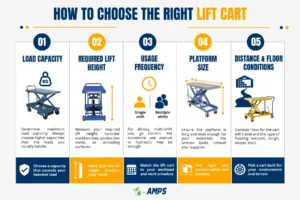
How to Choose the Right Lift Cart
Now that you know the primary types of lift carts, which one should you choose?
- First, focus on load capacity. Find out the maximum load the mobile unit will have to lift and don’t buy based on average loads. Think worst-case scenario.
- Then measure your required lift height. Do the materials need to be lifted onto a production process level or workbench? If so, how tall is this elevated platform? Are you going to use a mobile lift for unloading? What is the surface height the cargo needs to be loaded to?
- Consider usage: if this will be needed all day on many shifts, an electric model is preferable, but a manual or hydraulic may suffice for only occasional use.
- Mobile lift units come in various sizes of table/platforms-the total width and length need to hold the materials that will need to be lifted. If stability of uneven materials on top of even these platforms is an issue, consult with the equipment supplier.
- And finally, how far is the unit traveling in your plant facility? Ensure floor and type of material handling (smooth, rough, etc.) are a fit to make the mobile unit’s movements appropriate for your setting.

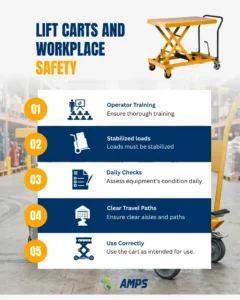
Lift Carts and Workplace Safety
Equipment selection is only a part a safe material handling operation. Operators must be trained on the cart’s controls, load limits, correct operating procedures, and boundaries. Loads must be stabilized on the load-bearing surface, and the operator must not allow loading over the manufacturer’s weight limitation.
Make sure daily equipment checks include assessing the condition of wheels and casters, hydraulic components, batteries, platforms, handles, and so on according to the manufacturer’s recommendations.
Clear travel paths must also be maintained. A well-balanced cart is difficult to maneuver efficiently and safely when traveling on a littered and worn floor. Safety can work in harmony with efficient material handling.
Final Thoughts
To determine which lift cart best fits your needs, consider a number of important factors, such as load capacity and lifting height; how frequently it will be used; its platform size; and your work environment. AMPS Supply carries numerous types of lift carts, including:
- Steel Hydra Lift Cart
- Steel Premium Scissor Lift Cart
- Steel Premium Double Scissor Lift Cart
- Steel DC Heavy Duty Low Profile Scissor Lift Cart
- Carbon Steel Air Carts
Each of these material handling solutions, offered in a variety of capacities and operating methods, is designed to help with warehouse, shop, manufacturing and other industrial applications.
FAQs
A lift cart is one of several material handling carts that is mobile and capable of raising, lowering and transporting loads from place to place. A lift cart has a horizontal platform so workers can place a load to a comfortable working height.
Lift carts can be used for moving boxes, tools, equipment, parts, etc. They can be found in warehouses, factories, maintenance operations, assembly lines and distribution facilities.
A regular cart moves loads horizontally from one location to another. The key difference, however, is that a lift cart can move loads horizontally as well as up and down.
There are 3 common types of lift carts including mechanical/hydraulic lift carts, electric lift carts and pneumatic lift carts.
There may be some overlap. Typically a lift table cart is a cart with a movable platform that lifts materials. A hydraulic lift cart is one that uses hydraulics to raise the platform. One product can therefore fulfill the functions of both!
Load capacities will vary per model with some designed to lift lighter loads and heavier duty models capable of handling thousands of pounds. Always review the manufacture’s load capacity and never exceed recommended guidelines.
Some units may offer limited lifting height while others are capable of lifting to heights up to several feet. When choosing, be mindful of both the minimum and maximum height your lift cart should reach.
Not necessarily. If you will be infrequently raising objects a manual lift cart may be more appropriate. However, if you will be regularly raising equipment or materials throughout the work day a electric powered model can certainly reduce manual effort.
Yes. Pneumatic lift carts, like many of their hydraulic counterparts, work via a powered raising action and utilize a compressed air-powered lifting cylinder to operate their mechanism. If your facility already uses compressed air then a pneumatic cart may be ideal.
This is the most important consideration. Begin with what you want to lift — the dimensions and total weight of the object to be lifted. Once you determine your product’s specs you will then determine how much you need the load to be lifted. Consider the available platform sizes, any space limitations for storing the cart when not in use. Then consider your workplace environment – is the cart in the same place everyday?

