



- Facility Maintenance

Light Duty Tilt Truck
- Forklift Attachments

Full Featured Work Platform
- Lifting Equipment

Gantry Crane

Stabilizing Jack
- Packaging Equipment

Auto Stretch Wrap Machine
- Safety and Security Equipment
- Storage Solutions

Carton Flow Rack

Cantilever Rack

Pallet Rack Guard
- Caster and Wheels


What Types of Column Protectors Are Available

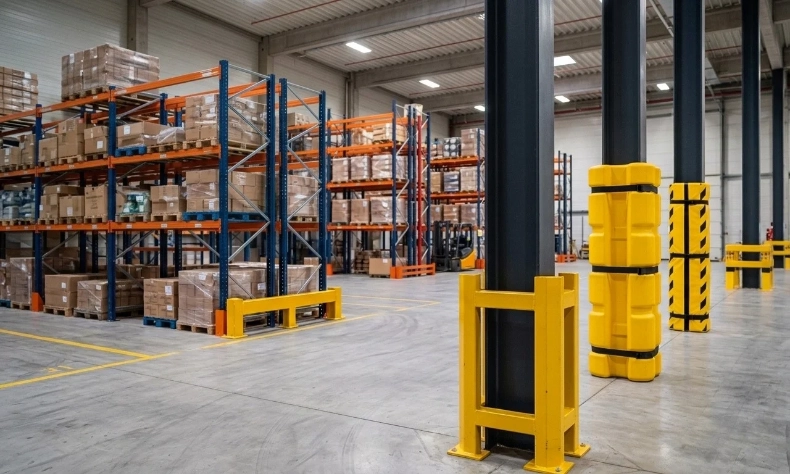
When you enter a warehouse, manufacturing plant, or distribution center, you often see long columns extending from the roof to the concrete foundation; these are columns that keep the building’s structure safe and stable. However, these columns are often exposed to direct impact from forklifts, pallet jacks, and other material handling equipment. A single hit, and you can say goodbye to that safe and sound structure. Column protectors are designed to reduce damage caused by impact and improve warehouse safety. Understanding the types of column protectors can help managers choose the right column guard to ensure structural stability.
Column protectors come in various types based on their shape, mounting style, and material. By the end of this article, you will learn about the various types and benefits of column protectors so you can choose the most suitable one for your facility.
What Are Column Protectors?
Column protectors are “guards” that are designed to protect vulnerable structural components from impact and damage. As building columns support the structure’s weight, a hard impact can weaken the support and result in dangerous accidents. In many warehouses, column protectors act like a shield around the key spots. How they work depends on the type. Some models can take in part of the hit. Others can move the impact away so the equipment does not touch the column head-on. These guards are a piece of a broader safety effort at work. Still, they do not make a column totally unbreakable.
What Types of Column Protectors Are Available by Material?
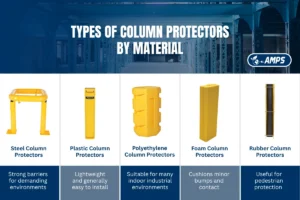
1. Steel Column Protectors
Steel column protectors are designed from steel sections or plates to provide strong physical protection against collisions. These barriers are especially useful in busy workplaces where the building columns are constantly exposed to collision threats. A steel column’s performance depends on its impact rating, guard design, and anchoring method.
Key benefits:
- Strong construction for demanding environments
- Suitable for many high-traffic areas
- Can provide substantial impact protection when properly engineered
- Available in different shapes and mounting configurations
2. Plastic Column Protectors
Plastic column protectors are used in less busy work zones to offer protection against minor collisions. These lightweight barriers are not always intended to provide impact protection; they are also used to prevent scratches and damage to surface areas.
Key benefits:
- Lightweight and generally easy to install
- Available in highly visible colors
- Prevent dampness and rust
- Best suited for low-traffic or light-duty use
3. Polyethylene Column Protectors
Polyethylene is a plastic known for better toughness than typical plastics. It also holds up well around moisture. Polyethylene protectors are built to soften hits from different angles; this can make them a solid safety upgrade in busy aisles. They also fit dock areas, equipment zones, and storage spots.
Key benefits:
- Resistant to moisture and corrosion
- Available in different shapes and sizes
- Suitable for many indoor industrial environments
- Can offer a durable alternative to certain metal coverings
4. Foam Column Protectors
Foam column protectors are padded barriers that use cushioning material to prevent collision impacts. They are suitable for areas where minor bumps or scrapes are likely to occur. They are not the best fit when forklifts operate close to building columns.
Key benefits:
- Cushions minor bumps and contact
- Helps protect people and equipment from hard edges
- Lightweight and easy to fit around suitable columns
- Useful in selected pedestrian and light-duty areas
5. Rubber Column Protectors
Rubber column protectors give a cushioned layer of protection when vehicles hit a post. You can see them in parking garages, on loading docks, and inside factories. Their purpose is to absorb the impact caused by minor crashes. How well they work depends on two things. First, the rubber thickness. Second, how the unit is mounted.
Key benefits:
- Provides cushioning against minor impacts
- Can resist everyday wear in suitable environments
- Available in different shapes and thicknesses
- Useful for pedestrian protection applications
What Types of Column Protectors Are Available by Design?
1. Bolt-On Column Protectors
Bolt-on column protectors use bolts and mechanical fasteners to attach the guard to the column. Some protectors are secured to the floor and around the structural support.
Best suited for: Applications that require a securely mounted protective guard.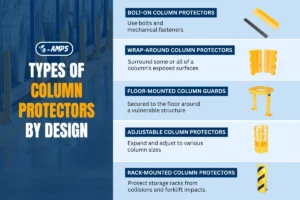
2. Wrap-Around Column Protectors
Wrap-around guards surround some or all of a column’s exposed surfaces. They are available in different materials and can protect multiple sides of a column.
Best suited for: Columns that may be approached by vehicles from different directions.
3. Floor-Mounted Column Guards
Floor-mounted column guards are secured to the floor around a vulnerable structure.
Best suited for: Busy loading areas and industrial workspaces where stronger separation is needed.
4. Adjustable Column Protectors
Adjustable column protectors expand and adjust to various column sizes and installation requirements.
Best suited for: Facilities with varying column dimensions and installation constraints.
5. Rack-Mounted Column Protectors
Rack-mounted column protectors protect storage racks from collisions and forklift impacts. Rack guards and building column protectors are designed for different applications and should not be used interchangeably.
Best suited for: Storage aisles and warehouse racking systems.
Column Protection Products Available from AMPS Supply
AMPS Supply offers a wide variety of column and structural guards. Each product is suited for specific applications and cannot be used as a substitute for other applications.
- Gantry/Jib Guard (CG)
- Removable Machine Guards & Bollards (HPRO-R)
- Building Protective Column Pads (V-PAD)
- Building Column Protectors (VB)
- Hexagonal Column Guards (HEX)
- Heavy Duty Column Protectors (CGP)
How to Choose the Right Column Protectors
Assess Forklift Traffic
Assess vehicle and equipment traffic around building columns. Does your facility have tight turns, narrow aisles, and busy work zones? In this scenario, stronger column protection is required. The type of forklift, its speed, and the weight of loads it carries also matter. Steel guards or high-density polyethylene column protectors are the most suitable here.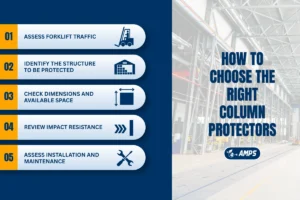
Identify the Structure Being Protected
Determine the type of structure being protected – a building column, a machine, a rack I-beam, or a crane support. Each structure has different requirements and requires a specific guard protector.
Check Dimensions and Available Space
Check dimensions of the columns and account for available space. An adjustable column protector is suited for facilities with varying column sizes. Consider clearance space required for equipment and workers. A guard should improve workplace safety without causing any spatial obstruction.
Review Impact Resistance
Column protectors do not carry the same level of impact resistance. Some guards are intended to protect surfaces from minor contact, while others are designed to absorb impact force caused by strong collisions. Before choosing a column guard, review the manufacturer’s specifications and information available related to impact testing. Consult a professional to determine the appropriate level of resistance required for your unique operations.
Consider Installation and Maintenance
Consider the type of installation required for the column protector you choose. Check if it requires fasteners or special tools. Carry out regular maintenance and check for any signs of deformation or damage. If the guard is unfit for continued us then change it on a prompt basis.
Final Thoughts
Column protectors help reduce the impact of collisions and the risk of damage to structural columns. They come in various compositions: plastic, polyethylene, foam, and rubber. Each column protector is suitable for different applications.
Before you buy, check the manufacturer’s details and the installation steps. Confirm the column protector suits your site’s needs. A protection plan that is set up well can cut down on unnecessary repairs. It can also help protect important parts of your facility and support safer work in the warehouse.
FAQs
Steel guards are common. Plastic column protectors are also used. Polyethylene protectors are used too. Foam and rubber guards show up in some setups.
There is not one single best option. The right choice depends on how your space is used, how much forklift traffic you have, and how much impact protection you need.
Not always. Steel may work well when impacts are heavy. Plastic and polyethylene can be helpful when you want corrosion resistance or other practical benefits.
They can matter for warehouse safety. This is especially true when forklifts move near support columns.
Column protectors are made for building columns and other structural supports. Rack guards are made to protect rack uprights and other racking parts from forklift hits.
Some are made for impact protection. Others are mainly meant to cover surfaces or handle light contact.
Building Protective Column Pads, also called V-PAD, provide a protective covering for building columns.
No. They can lower the chance of damage, but no guard can be treated as able to take every kind of hit.
Check them often as part of your site safety routine. This matters even more in areas with heavy traffic, especially if forklifts pass close by.
Measure the column’s dimensions and assess the amount of clearance required around it. Consult a professional to figure out the right size for your unique site needs.

